Guide
Ice Maker Not Working: A Troubleshooting Guide
Work through the five things that actually stop a built-in ice maker, in the order a technician checks them - and find out which ones you can fix yourself before you call anybody.
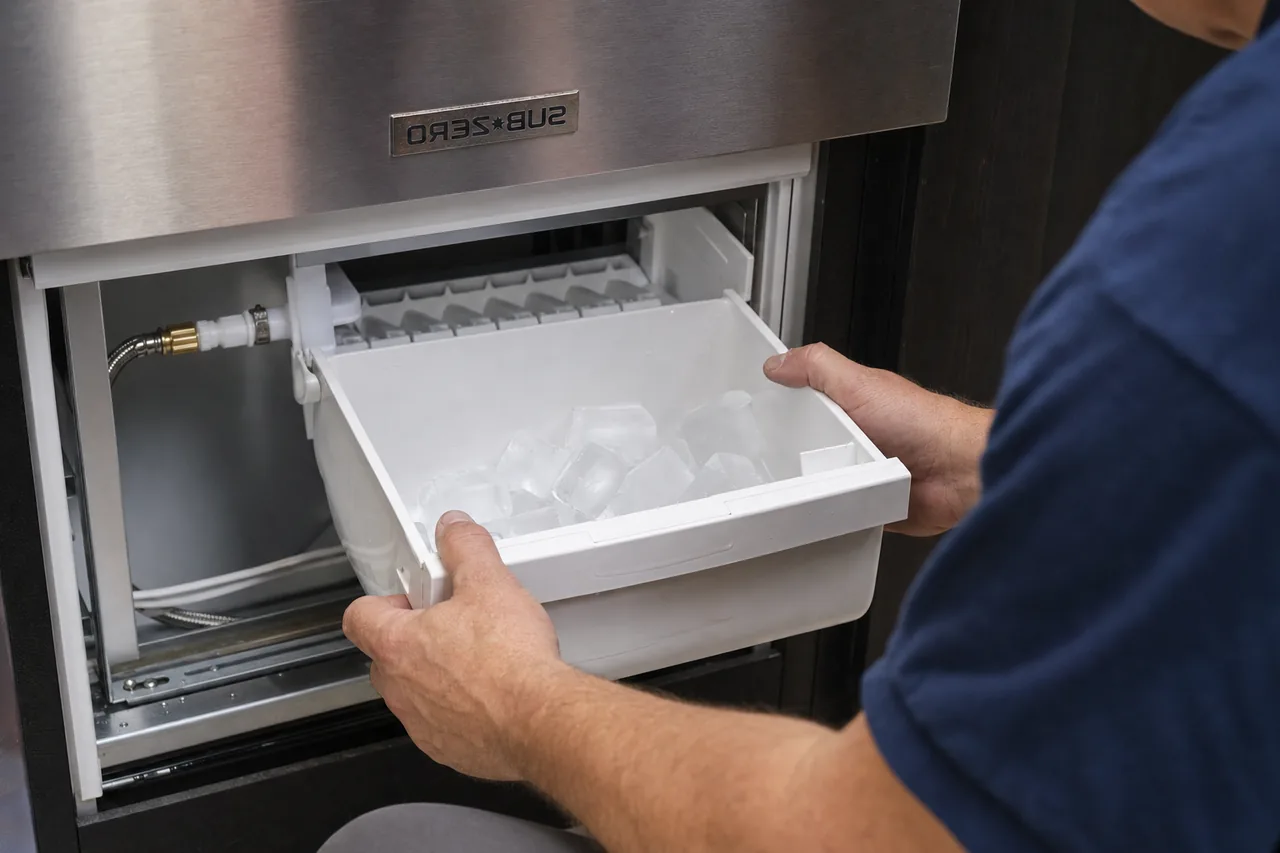
An ice maker that has stopped is one of the few appliance faults where a homeowner can genuinely narrow the problem down before a technician arrives. There are not many things that stop ice production, they fail in a fairly predictable order, and two of the five are things you can put right yourself in ten minutes.
This guide walks the checks in the order we actually do them on a call in Manhasset - cheapest and most likely first. Work down the list and stop at the first thing that is wrong.
Before anything else: has it been 24 hours?
A built-in ice maker that has just been installed, just been reset, or just had its water supply restored takes up to 24 hours to produce a normal harvest, and the first two batches are often discarded by the machine itself. A freezer that has been opened and reloaded - after a party, after a power cut - can also take most of a day to come back to a temperature at which the mold will release.
If the machine has been off for less than a day, the answer may be to wait.
Check 1: the arm, the switch, or the setting
Every ice maker has a way to be turned off, and it gets turned off by accident more often than anything else on this list fails.
On an older module ice maker, that is a wire bail arm: lifted, the machine stops. On newer Sub-Zero and Wolf refrigeration it is a setting in the control panel, and on some units it is a small paddle switch behind the bin. Anyone reaching into a full freezer can knock a bail arm up without noticing.
Look first. It costs nothing and it ends perhaps one call in eight.
Check 2: temperature, measured rather than read
An ice maker will not harvest if the freezer is not cold enough, and the display is not evidence. Put a thermometer on the shelf beside the ice bin and read it after a few hours.
The mold needs the compartment at or below 0°F to freeze and release on schedule. At 10°F to 15°F the machine will often make a few undersized cubes and then stall - which reads to a homeowner as “the ice maker is broken” when the actual fault is elsewhere in the refrigeration.
If the freezer is warm, stop here. The ice maker is a symptom, not the problem, and the question becomes why the compartment is not holding temperature - a fouled condenser, a stalled evaporator fan, or a defrost fault.
Check 3: water actually reaching the machine
This is where most genuine ice-maker faults live, and where Nassau County’s water makes itself felt.
Three things interrupt the supply:
- The shut-off valve behind or beneath the unit. Anyone who has worked on the plumbing may have closed it and not reopened it.
- The water filter. A filter past its service life restricts flow enough to underfill the mold long before it affects the drinking water dispenser. Hollow, thin, half-formed cubes are the classic sign.
- Scale in the fill tube and the inlet valve screen. Hard water leaves deposit in the narrow fill path, and the mold gets progressively less water per cycle.
A useful test: run the dispenser if the unit has one. Strong, steady flow means water is reaching the appliance and the restriction is downstream in the ice maker’s own fill path. Weak flow means the problem is upstream - filter or valve - and it is affecting everything.
Check 4: a frozen fill tube
If the fill tube ices over, each cycle adds a little more until the tube is blocked and the mold gets nothing. You will usually see a mound of ice above the mold or a solid plug where the tube enters.
The cause is almost never the tube. It is either an inlet valve that is weeping after it closes, dribbling water that freezes, or a compartment running colder than it should. Melting the plug clears the symptom for a week; replacing the leaking valve ends it.
Never chip at a fill tube or a mold with a knife or a screwdriver. The mold heater and the thermostat sit directly beneath the mold, and a punctured heater turns a valve job into a module replacement.
Check 5: the module, the thermostat, or the heater
If the arm is down, the freezer is at 0°F, water reaches the machine freely and nothing is frozen shut, the fault is inside the ice maker itself: the ejector motor, the mold thermostat that tells it when the cubes are frozen, or the mold heater that releases them.
This is the point at which the guide stops being useful. These parts are tested with a meter, not by eye, and on a Sub-Zero module the test involves jumping specific terminals in a particular order - done wrong, it damages the module. It is also, usefully, the only step on the list where the part is genuinely worn out rather than merely blocked.
What this looks like in Manhasset kitchens
Two patterns come up repeatedly in 11030 and the villages around it.
The first is scale. Nassau County’s water is hard, and homes here run built-in ice makers year round. Deposit accumulates in the fill tube and on the mold surface, the cubes come out thin and hollow, and the owner concludes the machine is dying when it needs descaling and a filter.
The second is the summer entertaining load. A standalone nugget or gourmet ice machine under a bar sits idle for ten months, then runs continuously through July and August. What fails is rarely the machine - it is the condenser, packed with a year of dust, in a cabinet with minimal ventilation. Clearing the air path and cleaning the condenser before the season is nearly the whole of the maintenance.
When to call
Call if the freezer is not holding 0°F, if the fill tube refreezes after you have cleared it, if water is reaching the appliance but not the mold, or if you have reached check 5.
Call (475) 268-8998. The diagnostic is $95 and it is credited toward the repair if you go ahead. Common ice-maker parts - inlet valves, fill tubes, modules for the usual Sub-Zero and Wolf units - ride on the truck, so most of these repairs finish in one visit, backed by a 1-Year Parts & Labor Warranty.
Have the model and serial number ready. It is on the plate inside the fresh-food compartment, usually on the upper left wall, and knowing it before we arrive is often the difference between one visit and two.